Diamond-Based Qubits: How CVD Plate Quality Affects Quantum Coherence Time
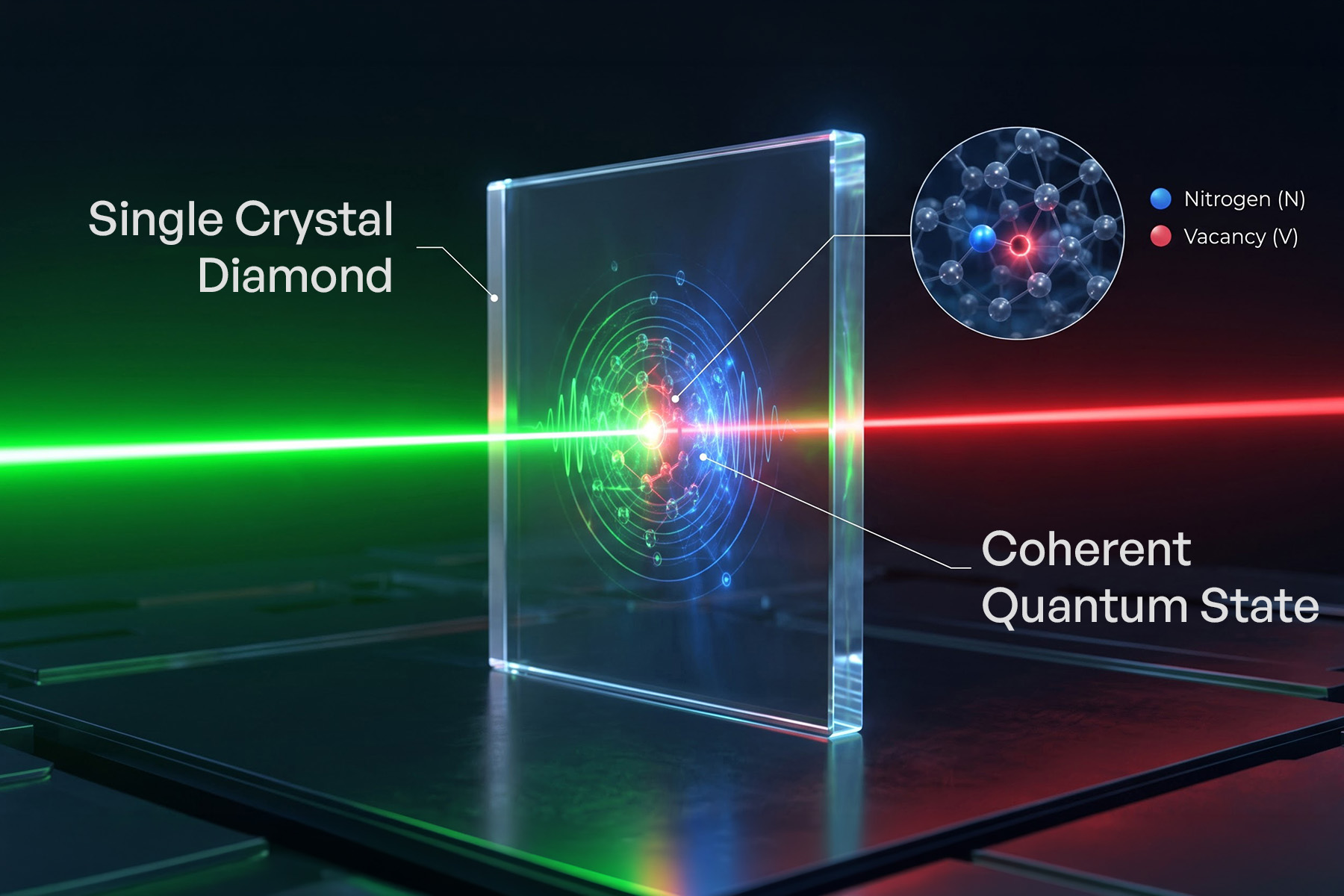
At present, CVD diamonds have gained significant popularity in quantum technologies, thanks to their nitrogen-vacancy (NV) centers. NV centers are atomic-scale defects in the diamond lattice that can act as qubits. The advantage of diamond-based qubits is that the quantum states can be controlled and measured using light and microwave signals even at room temperature. But the performance of a diamond-based qubit is dependent on both the NV center and the quality of the diamond surrounding it.
Some of the factors that can cause the qubit to lose its quantum state include: crystal defects, impurities, nitrogen concentration, and the surface condition. Here is where the 'quantum coherence time' becomes an important point of consideration. Also, the purity and structural quality of the diamond substrate can help achieve a stable and long-lasting quantum state.
In this blog, let us take a closer look at the relationship between CVD diamond quality, NV centers, and quantum coherence time.
What are Diamond-Based Qubits?
Diamond-based qubits are created using a very small defect inside the crystal structure of diamond. The nitrogen-vacancy (NV) center is considered to be an important and well-studied defect. When it comes to NV centers, one carbon atom is replaced by a nitrogen atom, and right next to it is an empty space where a carbon atom is missing.
NV center is formed when a nitrogen atom and a missing carbon atom combine together. The special electronic and spin properties of this tiny defect allow it to store, control, and read quantum information; hence, it can be used as a qubit.
Importance of Coherence Time
There are several reasons why the coherence time of qubits matters and is crucial. In this section, let us understand why the coherence time is important:
a. Quantum Computation Duration
A quantum algorithm involves a series of operations (quantum gates). Qubits must stay in their quantum states till the time the operations are completed. If the qubit loses its state too soon during the process, the algorithm will fail, and the result will be affected.
b. Error Rates
The longer the coherence time, the better the chances of reducing errors during quantum computations. During calculation, having a stable quantum state is necessary. If the quantum system loses its coherence too quickly, the final result will be impacted. This will cause the algorithm to produce incorrect or unreliable results.
c. Gate Operation Accuracy
Gate fidelity is closely linked to coherence time. Why so? Each and every gate operation takes some time, and during this time it gets exposed to noise from the environment, which will slowly affect the quantum state. If the qubit effectively maintains its quantum state for a long time, the chances of errors become less during operations. The quality of the diamond plays a crucial role in improving the gate fidelity. Factors such as Low nitrogen levels and carbon-13 impurities, less strain, and clean surfaces help qubits maintain their quantum states for longer.
d. Scaling Quantum Computers
If the quantum computer grows and uses more qubits, maintaining the stability of the qubit becomes a challenge. Each qubit can lose its quantum state through a process called "decoherence". With more qubits working together, there are more opportunities for these quantum states to be disturbed.
That is why longer coherence times are important for large-scale quantum computing. They allow qubits to maintain their quantum information for longer, giving the computer more time to perform complex calculations before the information is lost.
Factors That Affect Diamond Qubit Coherence
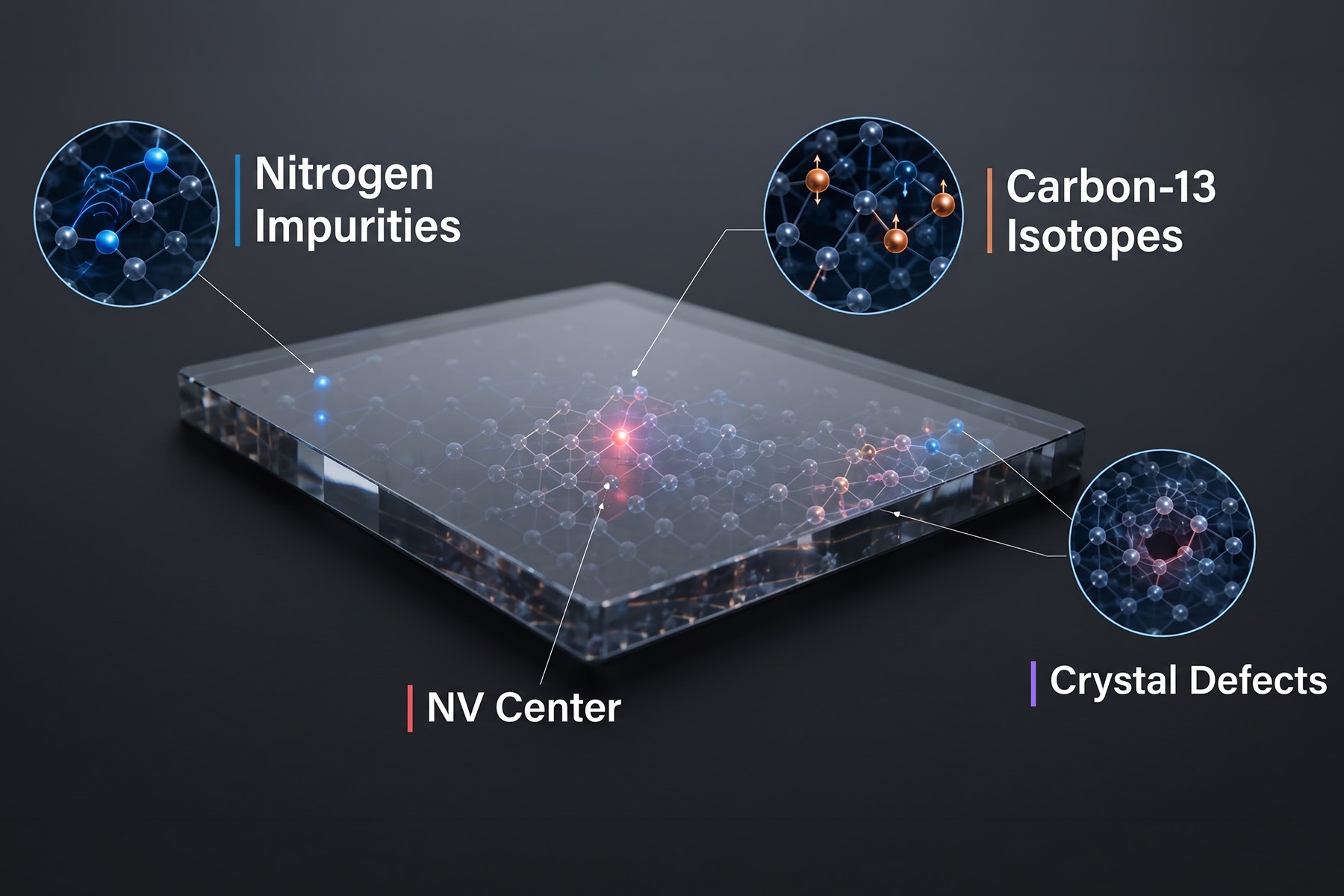
Diamond qubits are extremely sensitive to their surroundings. As the qubit is located inside the diamond crystal, if anything inside the crystal causes magnetic disturbances it can interfere with the qubit and cause it to lose its quantum state. In this section, let us look at the different factors that affect diamond qubit coherence:
1. Nitrogen Impurities
Nitrogen impurities are said to be one of the biggest sources of disturbance. Nitrogen atoms tend to have their own electron spins, which can create background magnetic noise around the qubit. This noise will disturb the qubit's spin and cause it to lose quantum information faster.
The amount of nitrogen has a direct impact on the qubit performance. The higher the nitrogen level, the more magnetic noise, and hence a reduction in coherence time. Low nitrogen levels will result in a quieter environment for the qubit. To sum up, the cleaner the diamond crystal, the quieter the environment around the qubit will be, and the longer the qubit will be able to maintain its quantum state.
2. Carbon-13 Content
Another source of magnetic noise that impacts a diamond qubit is carbon-13. As compared to the more common carbon-12, carbon-13 features a nuclear spin that can interact with the qubit and reduce its coherence time. Most diamonds are made of carbon-12, and only about 1% of them are carbon-13. Carbon-13 atoms feature a spinning nucleus that introduces 'noise' which disrupts the quantum states. When diamonds are made entirely from carbon-12, the noise gets removed, and the quantum states will last much longer.
3. Crystal Defects
In addition to the impurities, the quality of the lattice also plays an important role. Dislocations, vacancies, and other structural defects bring in local disturbances. This affects the qubit's energy levels, degrades coherence, and makes it difficult to control the qubits uniformly. But the use of single-crystal diamond under controlled conditions results in a low-defect and low-strain lattice that quantum applications need.
CVD Diamond Plates Are Beneficial For Diamond-Based Qubits
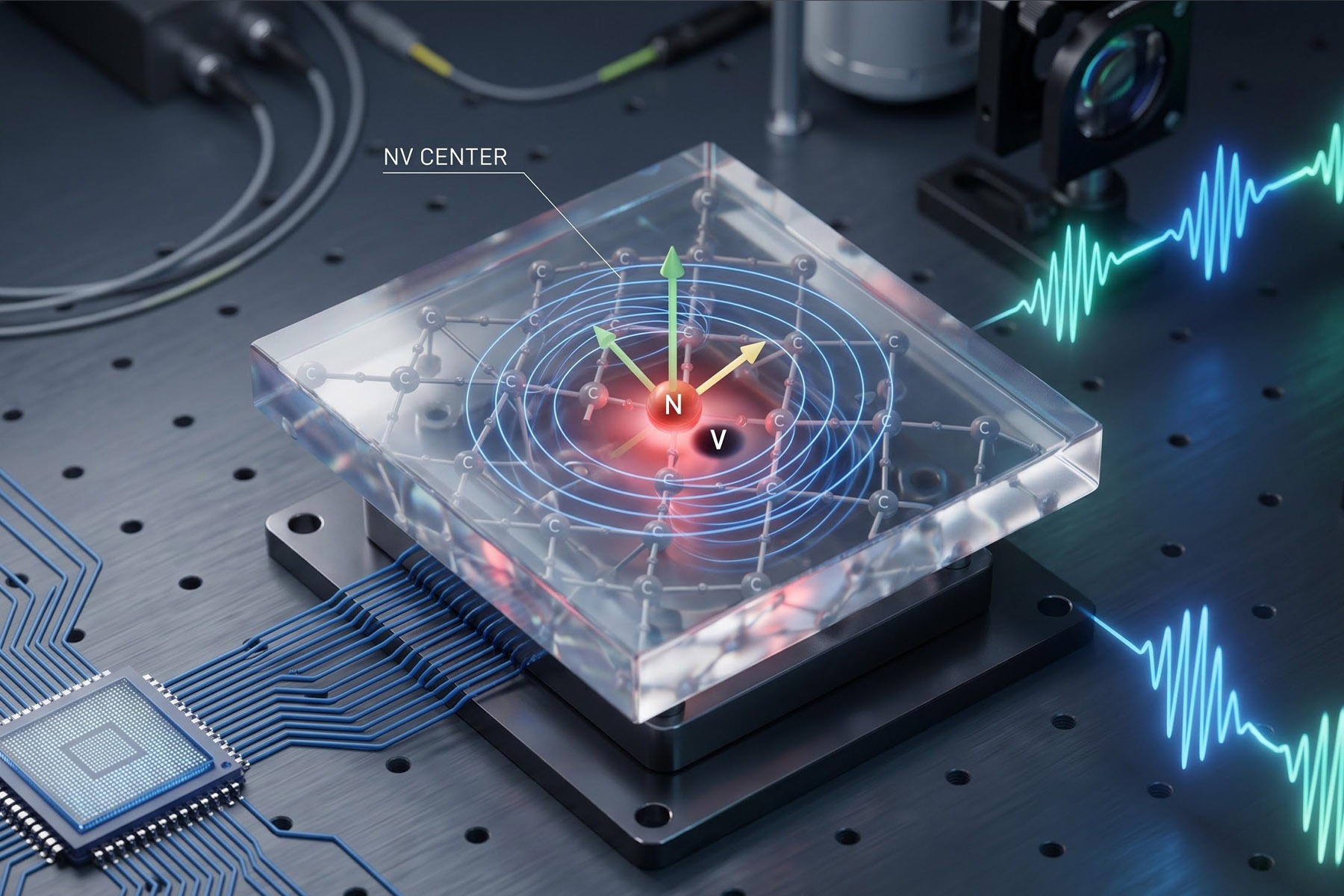
Here are the key reasons why CVD diamond plates are beneficial for diamond-based qubits:
1. High Purity
The magnetic noise around NV centers is reduced due to the low level of nitrogen and other unwanted impurities. This helps the electron spin remain in its quantum state for a long period, which results in longer coherence times.
2. Controlled Defects
NV centers are defects in the diamond crystal that can be used as qubits. NV centers are created intentionally since they have useful quantum properties.
3. Low Crystal Defects
Structural defects, including dislocations and lattice imperfections, will impact the NV center since it creates unwanted noise and affect the stability of the spin state of the NV center. These can be minimized during CVD diamond growth, which will result in a more uniform and stable crystal environment.
4. Long Coherence Times
NV centers have the ability to retain quantum information for long periods of time. This helps reduce errors and results in reliable quantum operations.
5. Control
Lights and microwaves can manipulate NV centers, while their spin state can be detected through fluorescence. This makes them particularly useful as controllable qubits.
Diamond Quality and Qubit Performance
In conclusion, quantum computers are an important and emerging technology. As compared to conventional supercomputers, quantum computers perform calculations and simulations in specific fields of application much faster. Qubits are the basic unit of information in a quantum computer.
Diamond-based qubits, using nitrogen-vacancy (NV) centers, offer promising possibilities for building stable quantum systems. Quantum computing is set to advance, which leaves room for high-quality CVD diamond materials to grow and contribute to more stable and reliable qubits.
Frequently Asked Questions
Here are some interesting FAQs on Diamond-Based Qubits:
“redefining one diamond layer at a time”
More Articles



Aga9 Systems is a lab-grown diamond manufacturing company dedicated to harnessing the valuable properties of CVD diamonds for industrial applications. We at Aga9 Systems manufacture more than lab-grown diamond plates, we are dedicated to creating brilliance ethically, sustainably and with maximum resource efficiency.